
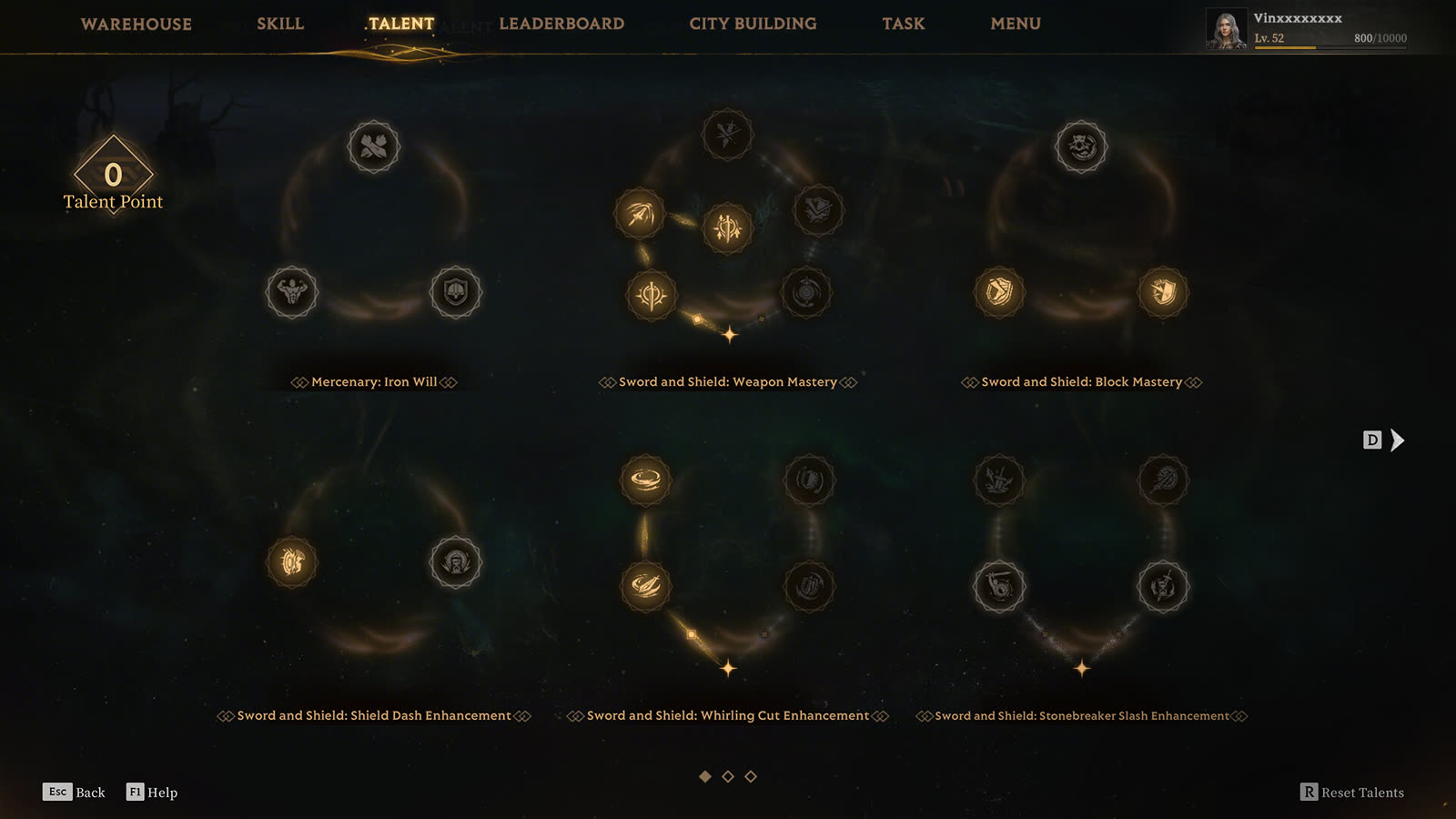
Respeccing is free, so hoarding points is a mistake
Both skills and talents can be changed at any time between rounds at no cost to the player. You cannot do it mid-match, but back at Windrest Camp you can rebuild your entire kit as often as you like. There is no reason to sit on unspent talent points waiting for certainty that a live-service balance patch will never give you.
Your specialisation decides how many slots each stance gets
The weapon specialisation tree is the first real build decision, and it trades breadth against depth. Using the Withered Knight as the worked example, the three routes are:
| Specialisation | Slots | What you gain |
|---|---|---|
| Primary stance | 3 primary + 1 secondary | Maximum damage scaling on your main stance |
| Secondary stance | 3 secondary + 1 primary | Flips the class into its other role entirely |
| Balanced | 2 + 2 | Reduced cooldowns across all your active skills |
Primary stance
- Slots
- 3 primary + 1 secondary
- What you gain
- Maximum damage scaling on your main stance
Secondary stance
- Slots
- 3 secondary + 1 primary
- What you gain
- Flips the class into its other role entirely
Balanced
- Slots
- 2 + 2
- What you gain
- Reduced cooldowns across all your active skills
Slot priority beats slot count
With one slot you take the panic button. With two you add the reliable setup tool. Only at three do you get to take the flashy mobility option. Ordering the picks this way survives balance patches because it is a statement about what a slot is for, not about which skill is currently strongest.
- Slot one: whatever in your kit can save you from a fight you misread.
- Slot two: whatever reliably starts your damage loop against a moving target.
- Slot three: mobility, repositioning, or a team utility button.
Skills that read strong and play weak
Two patterns recur across kits. Ranged applications of a melee class mechanic tend to be too slow to land against a competent target — the projectile is dodgeable and you are usually better off closing. And charge-forward abilities without super armour are traps, because any crowd control or hit from behind cancels them outright.
- A slow ranged debuff projectile is worse than an instant melee application at the range you will actually fight.
- A gap closer with no super armour is a gap closer that gets interrupted.
- A stationary defensive construct only pays off when you have teammates behind it — solo it makes you a target that can be ignored or hit with area damage.
Gems and affixes are the third build layer
Gear has sockets in four shapes, and gems come in matching shapes. Socketing a gem grants an affix, which is a stack of a specific buff. The prepare tab shows every attribute on your gear at once and how they synergise, which is the fastest way to spot that you have stacked three affixes that do not talk to each other.
Energy is the constraint the skill list does not show you
Skill panels list cooldowns, so builds get planned around cooldowns. Across the launch-week guides the thing that actually decides whether a kit functions is energy, and it never appears in the slot list. The pattern repeats across unrelated classes: the guide picks a cheap skill specifically so the expensive one stays castable, or takes a talent whose only job is refunding energy. Read a slot list with that in mind and some otherwise puzzling picks resolve.
| Class | What energy costs them | What the build does about it |
|---|---|---|
| Blackarrow | Bloodfly Arrow is the damage and it is expensive. Spend all three charges on nothing and only dodging is left | Charged shots become filler between debuffs, and Rapid Arrows is dropped in solo because the cost per arrow is not worth the burst |
| Shadowstrix | Named outright as the class’s binding constraint — how much energy you enter a fight with decides how far a won opening carries | Two talents exist to refund it, one on a mobility skill and one that pays out per enemy hit and per projectile reflected |
| Mercenary | Two charge skills already occupy the budget | The third slot goes to a deliberately cheap ranged option rather than a second expensive one |
Blackarrow
- What energy costs them
- Bloodfly Arrow is the damage and it is expensive. Spend all three charges on nothing and only dodging is left
- What the build does about it
- Charged shots become filler between debuffs, and Rapid Arrows is dropped in solo because the cost per arrow is not worth the burst
Shadowstrix
- What energy costs them
- Named outright as the class’s binding constraint — how much energy you enter a fight with decides how far a won opening carries
- What the build does about it
- Two talents exist to refund it, one on a mobility skill and one that pays out per enemy hit and per projectile reflected
Mercenary
- What energy costs them
- Two charge skills already occupy the budget
- What the build does about it
- The third slot goes to a deliberately cheap ranged option rather than a second expensive one